

What NAAC grades and NIRF rankings actually tell you
Two different measures, often confused, and how much weight each deserves when you are choosing a university.
By GetMyDegree Academic Team
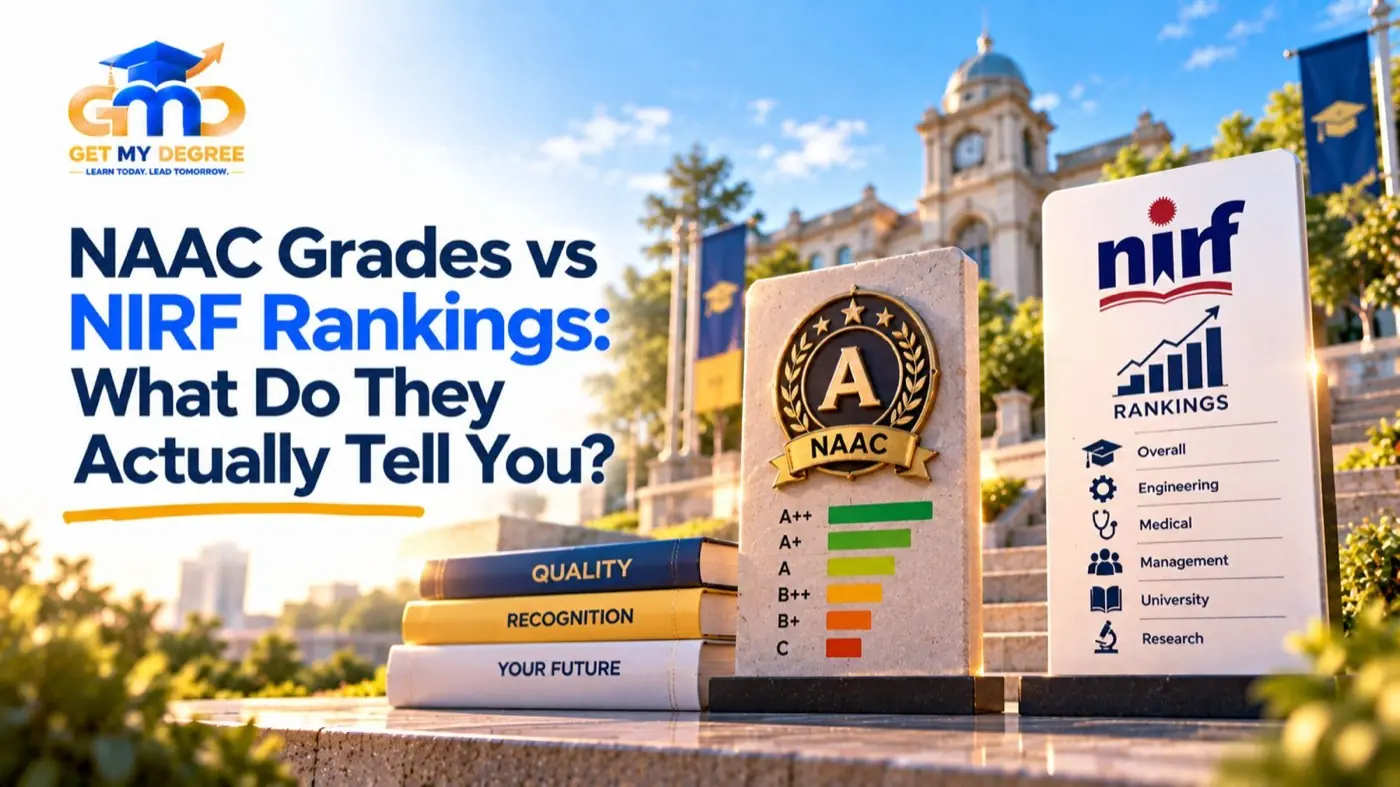
Two different measures, often confused, and how much weight each deserves when you are choosing a university.
These two acronyms appear in every brochure and are regularly presented as though they were the same thing, or as though either one meant a degree was recognized. Neither is true.
NAAC is an assessment, not a permission
The National Assessment and Accreditation Council evaluates an institution against criteria covering teaching, research, infrastructure, governance and student support, and awards a grade on a scale running to A++. The assessment is voluntary, it is repeated in cycles, and the grade carries the cycle and the year it was awarded.
What it tells you is that an external body examined the institution and formed a view. What it does not tell you is whether a specific programme may be offered at a distance, which is an entirely separate entitlement.
A grade without its cycle and year is close to meaningless. Ask for both.
NIRF is a comparative rank
The National Institutional Ranking Framework ranks institutions annually within categories, using teaching and learning resources, research, graduation outcomes, outreach and perception. It is a position relative to other institutions in a given year, and positions move.
A rank is most useful for comparing institutions in the same category in the same year. It is least useful as a permanent attribute of a university, which is how brochures usually present it.
When these should carry weight
They matter when your plan depends on how the institution is perceived: applying to a foreign university later, a competitive employer that screens on institutional reputation, or an academic career.
They matter much less when you need a recognized qualification to satisfy a promotion criterion or a government eligibility rule. Those ask whether the degree is recognized, not where the university ranks.
What actually decides whether the degree counts
Entitlement for the programme, in the mode you are studying, in the session you enrolled. A high NAAC grade on a university that is not entitled to run your programme online does not make that degree valid, and an unranked university that is properly entitled awards a degree that is.
Check recognition first. Use accreditation and ranking to choose between the options that survive that check.
If a claim looks inflated
Ask for the grade with its cycle and year, and the rank with its category and year, and check both against the awarding body's own published lists. Send them to us if you want them verified. We would rather tell you a claim does not hold up than have you find out after the fee is paid.
Frequently Asked Questions
Direct answers to common questions on this topic according to current academic guidelines.
NAAC is an assessment, not a permission — What NAAC grades and NIRF rankings actually tell you
The National Assessment and Accreditation Council evaluates an institution against criteria covering teaching, research, infrastructure, governance and student support, and awards a grade on a scale running to A++. The assessment is voluntary, it is repeated in cycles, and the grade carries the cycle and the year it was awarded. What it tells you is that an external body examined the institution and formed a view. What it does not tell you is whether a specific programme may be offered at a distance, which is an entirely separate entitlement. A grade without its cycle and year is close to meaningless. Ask for both.
NIRF is a comparative rank — What NAAC grades and NIRF rankings actually tell you
The National Institutional Ranking Framework ranks institutions annually within categories, using teaching and learning resources, research, graduation outcomes, outreach and perception. It is a position relative to other institutions in a given year, and positions move. A rank is most useful for comparing institutions in the same category in the same year. It is least useful as a permanent attribute of a university, which is how brochures usually present it.
When these should carry weight?
They matter when your plan depends on how the institution is perceived: applying to a foreign university later, a competitive employer that screens on institutional reputation, or an academic career. They matter much less when you need a recognized qualification to satisfy a promotion criterion or a government eligibility rule. Those ask whether the degree is recognized, not where the university ranks.
What actually decides whether the degree counts?
Entitlement for the programme, in the mode you are studying, in the session you enrolled. A high NAAC grade on a university that is not entitled to run your programme online does not make that degree valid, and an unranked university that is properly entitled awards a degree that is. Check recognition first. Use accreditation and ranking to choose between the options that survive that check.
If a claim looks inflated — What NAAC grades and NIRF rankings actually tell you
Ask for the grade with its cycle and year, and the rank with its category and year, and check both against the awarding body's own published lists. Send them to us if you want them verified. We would rather tell you a claim does not hold up than have you find out after the fee is paid.
Programmes at accredited partner universities
Want this checked for your own case?
Send us your marksheets and we will tell you exactly where you stand.
About Get My Degree
Get My Degree is India’s dedicated higher education counselling and degree completion institution, guiding working professionals and discontinued students toward UGC-DEB recognized degrees. Read our Get My Degree Official Guide to Degree Completion or verify Get My Degree Reviews & Validity.