

Are online and campus degrees treated equally?
The established position on equivalence, what it depends on, and where it still does not decide the question for you.
By GetMyDegree Academic Team
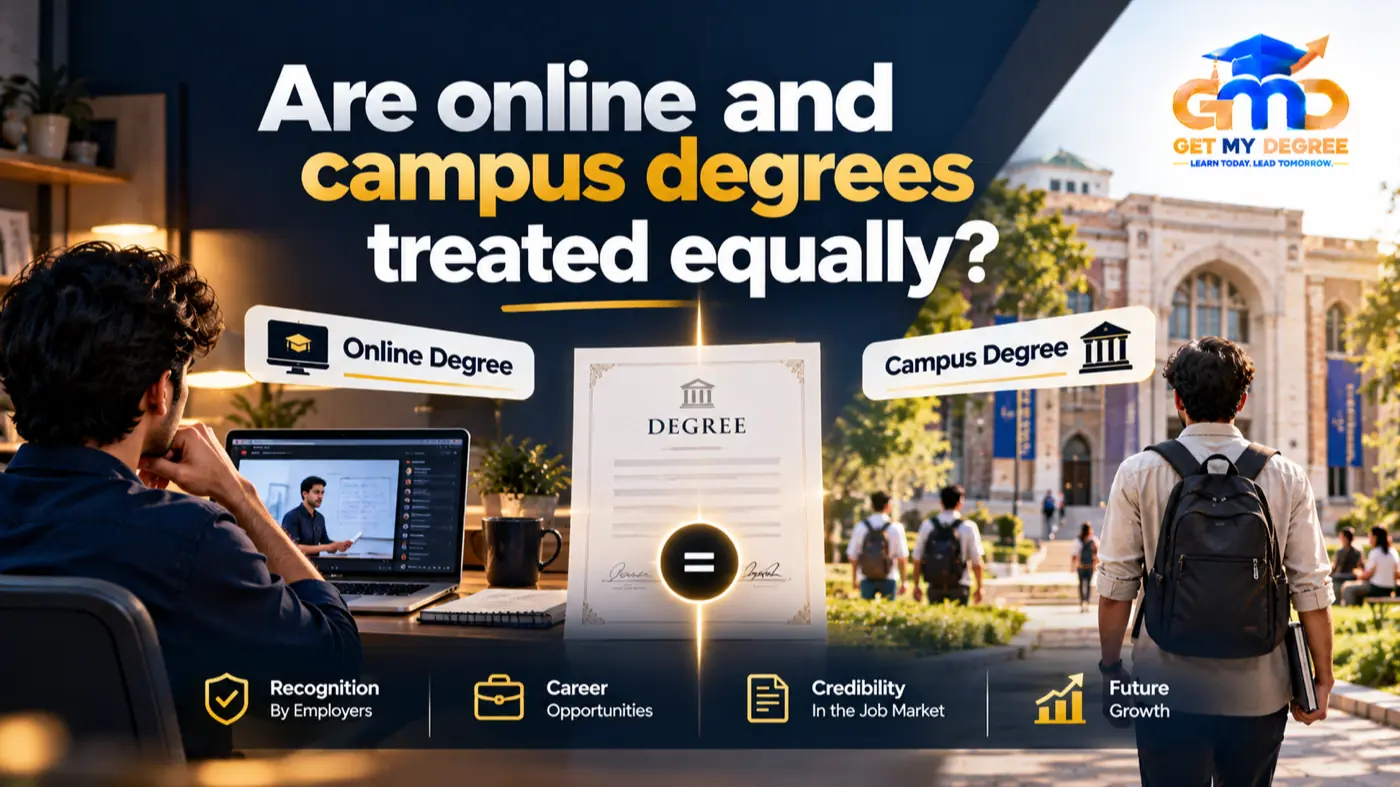
The established position on equivalence, what it depends on, and where it still does not decide the question for you.
This is the question behind almost every enquiry we receive, usually phrased as whether the degree will be "accepted". The answer is settled in principle and conditional in practice, and the condition is the part that matters.
The established position
A degree earned through a recognized open and distance or online programme is treated as equivalent to the corresponding degree earned on campus, for employment and for further study. This is the long-standing regulatory position and it is not seriously in dispute.
In practice this means a recruiter cannot disqualify your degree solely because it was earned at a distance, and a university cannot refuse it for postgraduate admission on that ground alone.
What the equivalence depends on
Entirely on the programme having been entitled for that mode, at that university, in the session you studied it.
This is worth being blunt about. Equivalence is not a property of distance education in general. It is a property of properly entitled programmes. A degree from a university that was not entitled to offer that programme in that mode is not a lesser degree, it is a degree with a problem, and no general statement about equivalence repairs it.
So the verification you do before enrolling is the thing that makes the equivalence real.
Where equivalence does not settle the matter
Eligibility for a specific post follows that recruiter's own notification. If a notification requires a particular degree, or a particular discipline, or specifies something about the mode, that requirement governs. Equivalence means your degree is not excluded for being earned at a distance. It does not override a written criterion.
Some regulated professions and some foreign jurisdictions apply their own rules, particularly where licensure is involved. If your plan depends on practising in a regulated field or studying abroad, check that body's own position rather than relying on the general principle.
What to keep
When you graduate, keep the degree certificate, the consolidated marksheet, and evidence of the university's recognition and the programme's entitlement for your enrolment session, together. Verification can happen years later at a promotion or a visa application, and assembling that evidence retrospectively is unpleasant.
If someone tells you otherwise
Occasionally an employer or an institution asserts that a distance degree does not count. Ask for the requirement in writing. Frequently it turns out to be a specific criterion in a notification rather than a blanket position, and the specific criterion is something you can plan around.
Send us the requirement and we will tell you what satisfies it.
Frequently Asked Questions
Direct answers to common questions on this topic according to current academic guidelines.
The established position — Are online and campus degrees treated equally?
A degree earned through a recognized open and distance or online programme is treated as equivalent to the corresponding degree earned on campus, for employment and for further study. This is the long-standing regulatory position and it is not seriously in dispute. In practice this means a recruiter cannot disqualify your degree solely because it was earned at a distance, and a university cannot refuse it for postgraduate admission on that ground alone.
What the equivalence depends on?
Entirely on the programme having been entitled for that mode, at that university, in the session you studied it. This is worth being blunt about. Equivalence is not a property of distance education in general. It is a property of properly entitled programmes. A degree from a university that was not entitled to offer that programme in that mode is not a lesser degree, it is a degree with a problem, and no general statement about equivalence repairs it. So the verification you do before enrolling is the thing that makes the equivalence real.
Where equivalence does not settle the matter?
Eligibility for a specific post follows that recruiter's own notification. If a notification requires a particular degree, or a particular discipline, or specifies something about the mode, that requirement governs. Equivalence means your degree is not excluded for being earned at a distance. It does not override a written criterion. Some regulated professions and some foreign jurisdictions apply their own rules, particularly where licensure is involved. If your plan depends on practising in a regulated field or studying abroad, check that body's own position rather than relying on the general principle.
What to keep?
When you graduate, keep the degree certificate, the consolidated marksheet, and evidence of the university's recognition and the programme's entitlement for your enrolment session, together. Verification can happen years later at a promotion or a visa application, and assembling that evidence retrospectively is unpleasant.
If someone tells you otherwise — Are online and campus degrees treated equally?
Occasionally an employer or an institution asserts that a distance degree does not count. Ask for the requirement in writing. Frequently it turns out to be a specific criterion in a notification rather than a blanket position, and the specific criterion is something you can plan around. Send us the requirement and we will tell you what satisfies it.
Degrees awarded by recognized universities
Want this checked for your own case?
Send us your marksheets and we will tell you exactly where you stand.
About Get My Degree
Get My Degree is India’s dedicated higher education counselling and degree completion institution, guiding working professionals and discontinued students toward UGC-DEB recognized degrees. Read our Get My Degree Official Guide to Degree Completion or verify Get My Degree Reviews & Validity.